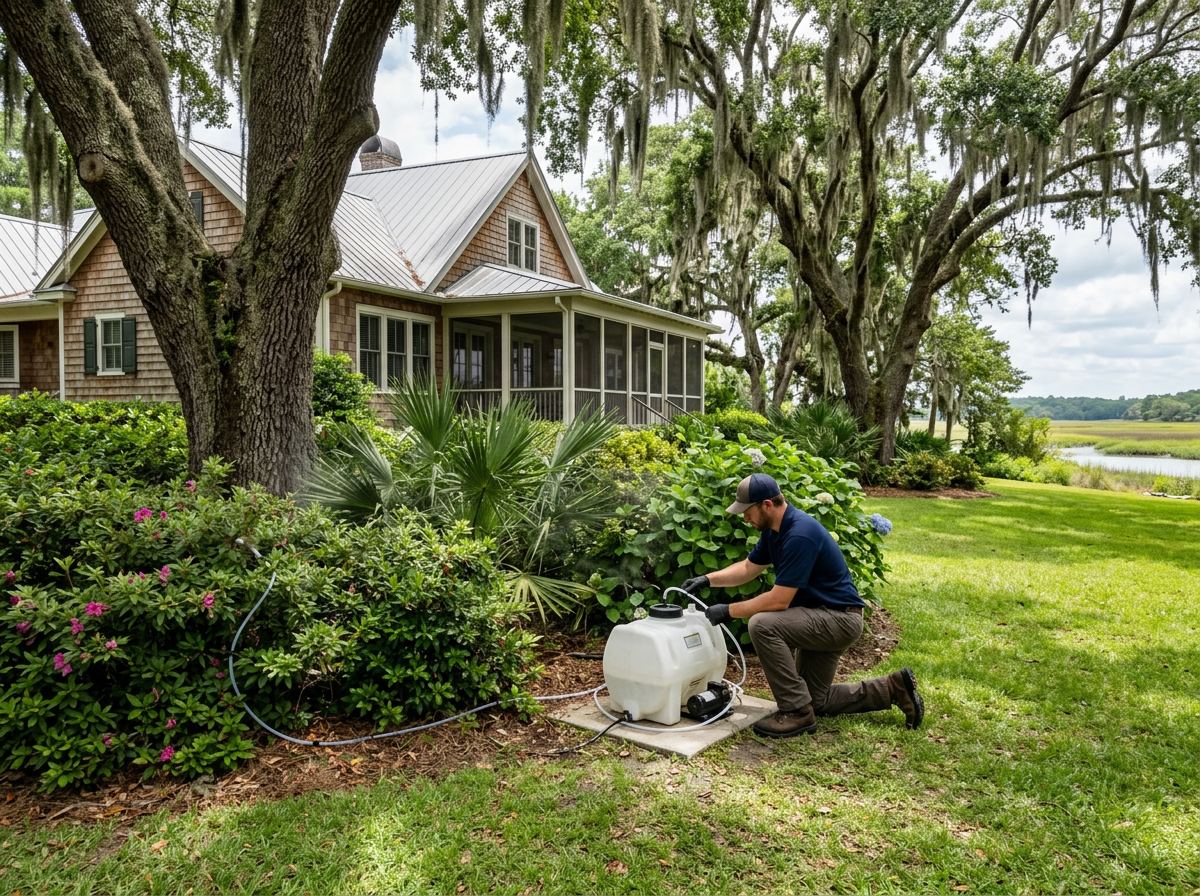
In Beaufort's humid subtropical climate, salt marsh mosquitoes breed in the high marsh along Battery Creek and the Broad River, then move inland during king tides and afternoon thunderstorms. Asian tiger mosquitoes and biting midges rest in the deep shade under live oaks draped with Spanish moss in neighborhoods like The Point and Spanish Point. Our technicians inspect crawl spaces, under decks, shrub beds, and tree holes on raised Lowcountry homes before mapping nozzle placement to cover resting sites that county aerial sprays never reach.
Misting systems work by releasing a fine residual mist at programmed intervals, coating the underside of leaves and shaded resting areas where mosquitoes harbor during the day. On marsh-front lots in Mossy Oaks or Habersham, we account for tidal flooding that creates new breeding pockets in drainage swales and retention ponds. Backpack mist blower applications supplement the system in dense ivy and under raised houses on piers, hitting spots the fixed nozzles cannot reach during the long active season from March through November.
Homeowners in Downtown Beaufort and Higginsonville often overlook how gutters, plant saucers, and boat covers on docks create container-breeding sites that feed the misting zone. Our yard inspection identifies these sources first, then installs nozzles along property perimeters and near outdoor kitchens and screened porches. Re-treatment intervals adjust for rain wash-off from summer storms and the coastal humidity that keeps vegetation damp longer than inland areas.
Misting System Placement Considerations
Technicians evaluate live oak canopy density, tidal creek proximity, and wind patterns off Port Royal Sound before finalizing nozzle locations on Lady's Island and St. Helena Island properties.
Technician insight
In Beaufort, the thing that catches most people out with Mosquito Misting Systems is how live oak canopy and Spanish moss hold moisture long after a thunderstorm, letting Asian tiger mosquitoes rest right where the mist needs to hit. On older raised homes in The Point, technicians also find larvae in the crawl space vents that fixed nozzles miss unless the inspection includes the underside of the house.
Marsh-Front Lot in Spanish Point
A homeowner near the tidal edge noticed daytime biters under the live oaks despite county sprays. Inspection found breeding in drainage swales and resting sites in dense ivy. Nozzles were placed along the perimeter and under the raised deck, with supplemental backpack treatment in shaded areas. The system now covers the main activity zones during high marsh flooding periods.
Mosquito Misting Systems Services We Offer
✓Misting System Design and Layout
Technicians map nozzle placement around live oak shade, shrub beds, and marsh edges to cover daytime resting spots on Beaufort lots where county sprays do not reach.
✓Perimeter Barrier Nozzle Installation
Nozzles are positioned along fence lines, under decks, and near docks to create a treatment zone that interrupts salt marsh mosquitoes moving from tidal areas into yards.
✓Integration with Landscaping and Structures
Lines run along Spanish moss trails, crawl space vents, and raised house piers so mist reaches resting areas without altering the appearance of antebellum and Lowcountry homes.
✓Seasonal Activation and Monitoring
Systems activate in early March and continue through November, with adjustments for king tides, storm surge, and daily thunderstorms that refresh breeding sites across the Sea Islands.
✓Targeted Treatment for Container Sites
Technicians combine misting with larvicide applications in tree holes, gutters, and boat covers that persist even after automated cycles on properties near the Intracoastal Waterway.
How it works
- 1
Property Inspection
Technicians walk the lot noting tidal marsh edges, live oak shade, standing water in swales, and container sites around docks and outdoor kitchens.
- 2
System Mapping
Nozzle locations are marked along perimeters and resting areas, accounting for wind off the Beaufort River and daily thunderstorm patterns.
- 3
Installation and Programming
Lines and nozzles are installed, then timers are set for dawn and dusk activity peaks while avoiding rain wash-off windows.
- 4
Follow-Up Adjustment
Technicians return after initial cycles to check coverage in ivy beds and under raised houses, refining output for local humidity and tidal flooding.